Telecommunications Blog: Communications

A blog for mobile communications systems GSM , UMTS and LTE

Recomended

Showing posts with label Communications. Show all posts

Saturday, July 19, 2014

The public telephone networks

7/19/2014 11:54:00 AM 1
The public telephone networks


Telephone networks are known as public telephone networks.

They consist of :
  •  Trunk exchange .
  •  Local exchange .
  •  And lines between them .
The lines can be divided into trunk lines and local lines.

Simplified Trunk Cable Diagram

1- The Trunk Networks


Lines which are used for trunk traffic only are described as trunk lines . These networks can be designed as :
  •  Meshed networks
  •  Star networks
  •  Or mixed networks
  • Transmission medium
  •  Symmetric copper pair
  •  Coaxial copper cable
  •  Optical fiber
  •  Air (radio )


Trunk /network Configuration


Saturday, February 4, 2012

INTRODUCTION TO RF PLANNING 2

2/04/2012 10:22:00 AM 1
INTRODUCTION TO RF PLANNING 2
TOOLS USED FOR RF PLANNING :

• Network Planning Tool
• CW Propagation Tool
• Traffic Modeling Tool
• Project Management Tool


Network Planning Tool :

• Planning tool is used to assist engineers in designing and optimizing wireless networks by providing an accurate and reliable prediction of coverage,  doing  frequency planning  automatically,  creating neighbor lists etc.


•  With a database that takes into account data such as terrain, clutter, and  antenna radiation patterns,  as  well  as  an intuitive  graphical interface, the Planning tool gives RF engineers a state-of-the-art tool to:

       – Design wireless networks
       – Plan network expansions
       – Optimize network performance
       – Diagnose system problems
• The major tools available in the market are Planet, Pegasos, Cell Cad.
• Also many vendors have developed Planning tools of their  own like Netplan by Motorola, TEMS by Ericsson and so on.

Monday, December 26, 2011

INTRODUCTION TO RF PLANNING 1

12/26/2011 10:19:00 AM 1
INTRODUCTION TO RF  PLANNING 1
• Designing a cellular system - particularly one that incorporates both  Macrocellular  and Microcellular  networks  is  a delicate  balancing  exercise.

• The goal  is  to  achieve  optimum  use  of  resources and maximum revenue potential whilst maintaining a high level of system quality.

• Full consideration must also be given to cost and spectrum allocation limitations.

• A properly  planned system  should allow  capacity  to  be added economically when traffic demand increases.

• As every urban environment is different, so is every macrocell and microcell network. Hence informed and accurate planning is essential in order to ensure that the system will provide both the increased capacity and  the  improvement  in network  quality where  required,
especially when deploying Microcellular systems.


• RF planning plays a critical role in the Cellular design process.

• By doing a proper RF Planning by keeping the future growth plan in mind we can reduce a lot of problems that we may encounter in the future and also reduce substantially the cost of optimization.

• On the other hand a poorly planned network not only leads to many Network problems , it also increases the optimization costs and still may not ensure the desired quality.

Tuesday, September 13, 2011

Introduction to Antenna

9/13/2011 06:34:00 PM 0
Introduction to Antenna
  • An antenna is an electrical conductor or system of conductors
             * Transmission - radiates electromagnetic energy into space
             * Reception - collects electromagnetic energy from space
  • In two-way communication, the same antenna can be used for transmission and reception


Antenna Definition

   An  antenna  is  a  circuit  element that  provides  a  transition  form  a guided wave on a transmission line to  a  free  space  wave  and  it provides  for  the  collection  of electromagnetic energy.

  In  transmit  systems  the  RF  signal  is generated,  amplified,  modulated  and applied to the antenna.

   In receive systems the antenna collects electromagnetic  waves  that  are “cutting”  through the  antenna  and induce  alternating  currents  that  are used by the receiver.

Polarization


   Polarization  is  the  direction  of  the  electric field and is the same as the physical attitude of the antenna.
 
          - A  vertical  antenna  will  transmit  a  vertically polarized wave.

  The  receive  and  transmit  antennas  need  to possess the same polarization.

Tuesday, May 3, 2011

Wireless Ad hoc Networks

5/03/2011 10:59:00 AM 1
Wireless Ad hoc Networks
  Wireless ad hoc networks have special characteristics related to node mobility, node self-configuration and the lack of centralized access points (APs). However, wireless ad hoc technologies have several disadvantages when compared to traditional wireless
networks, including their limited resources, such as:

       ** Lower processing capacity
       ** Limited memory
       ** Battery dependency

  Because operations are not centralized in a single access point, information is openly distributed among the network nodes. As a result, wireless ad hoc networks are not as secure as typical wireless networks.

  Wireless ad hoc networks are usually associated with wireless mesh networks; however, these two concepts can be dealt separately.

  The essential idea of wireless ad hoc networks is that they are mobile and dynamic. This
concept is not at all new.
Source : IEEE

Sunday, April 3, 2011

SS7 Basics

4/03/2011 04:15:00 PM 0
SS7 Basics
SS7 Protocol :


     The primary signaling protocol in use today is signaling systems 7(SS7), which interconnects networks such as SSP, SCP .

     The SS7 Protocol stak consist in several individual protocols, including Message Transfer Part (MTP) level1,2 and 3, Integrated services Digital Network User Part, Signaling Connection Control Part (SCCP), and the Transmission Capabilities Application Part (TCAP) working together, these protocols define the format for all SS7 messages, as well as the procedures by which messages are generated and processed.
    

Saturday, January 22, 2011

PE license and exams

1/22/2011 05:50:00 AM 0
PE  license and exams
The PE exam tests your ability to practice competently in a particular engineering discipline. It is designed for engineers who have gained at least four years’ post-college work experience in their chosen engineering discipline. The PE exam is typically the last step in the process of becoming a licensed P.E.

PE exam specifications and design standards

Agricultural
Architectural
Chemical (updated for April 2011 exam)
Civil: Construction
Civil: Geotechnical
Civil: Structural
Civil: Transportation
Civil: Water Resources and Environmental
Control Systems (updated for October 2011 exam)
Electrical and Computer: Computer Engineering

Tuesday, January 18, 2011

Introduction to 802.11 Standard

1/18/2011 02:56:00 PM 0
Introduction to 802.11 Standard
     IEEE 802.11 standard specifies a 2.4 GHz operating frequency with data rates of 1 and 2 Mbps using either Direct Sequence Spread Spectrum (DSSS) or Frequency Hopping Spread Spectrum (FHSS). The IEEE 802.11a standard specifies an OFDM physical layer (PHY) that splits an information signal across 52 separate subcarriers to provide transmission of data at a rate of 6, 9,12, 18, 24, 36, 48, or 54 Mbps. In the 802.11a IEEE standard the 6, 12, and 24 Mbps data rates are mandatory. Four of the subcarriers are pilot subcarriers that the system uses as a reference to disregard frequency or phase shifts of the signal during transmission.
 

Sunday, January 16, 2011

Basic commands and syntax in MATLAB

1/16/2011 12:46:00 PM 0
Basic commands and syntax in MATLAB
    We will speak about Basic commands and syntax in MATLAB to show how we can write code in it .

    If you type in a valid expression and press Enter, MATLAB will immediately execute it and return the result.

>> 2+2
ans =
           4

>> 4ˆ2

ans =
           16

>> sin(pi/2)

ans =
           1

>> 1/0


Intro to MATLAB

1/16/2011 12:30:00 PM 1
Intro to MATLAB
     MATLAB is a software package for computation in engineering, science, and applied mathematics. It offers a powerful programming language, excellent graphics, and a wide range of expertknowledge. MATLAB is published by and a trademark of The MathWorks, Inc.


     The focus in MATLAB is on computation, not mathematics. Hence symbolic expressions and manipulations are not possible (except through a clever interface to Maple). All results are not only numerical but inexact, thanks to the rounding errors inherent in computer arithmetic. The limitation to numerical computation can be seen as a drawback, but it is a source of strength too: MATLAB generally runs circles around Maple, Mathematica, and the like when it comes to numerics.

Wednesday, January 12, 2011

What's OFDM-MIMO ?

1/12/2011 11:11:00 AM 1
What's OFDM-MIMO ?
 Multiple Input Multiple Output (MIMO)

     One building block for next-generation wireless access, MIMO (multiple-input, multiple-output), is an advanced antenna technology that can carry 4 to 5 times more data traffic than today’s most advanced UMTS-HSDPA-ready (3G) networks. A network design incorporating MIMO technology provides the scalability needed to quickly deliver multimedia content to the mass market. With MIMO, for example, a ½ megabit picture can be downloaded in a half second or a 30-megabit video in half a minute. 

We know that there are 4 types : SISo , SIMO , MISO and MIMO  


SISo : Single i/p , Single O/p
SIMO : Single i/p , Multi o/p
MISO : Multi i/p , Single o/p


OFDM Advantages and Disadvantages

1/12/2011 11:01:00 AM 1
OFDM Advantages and Disadvantages
    The major advantage of OFDM is its robustness against multi path propagation. Thus, it is suitable to be implemented in wireless environments. The introduction of cyclic prefix made OFDM system resistance to time dispersion. OFDM symbol rate is low since a data stream is divided into several parallel streams before transmission. This make the fading is slow enough for the channel to be considered as constant during one OFDM symbol interval.


Orthogonal Frequency Division Multiplexing (OFDM)

1/12/2011 10:46:00 AM 1
Orthogonal Frequency Division Multiplexing (OFDM)
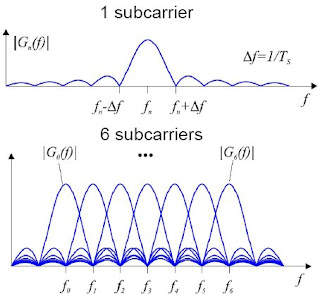
      Orthogonal Frequency Division Multiplexing (OFDM) is a multicarrier modulation technique. OFDM provides high bandwidth efficiency because the carriers are orthogonal to each other and multiple carriers share the data among themselves. The main advantage of this transmission technique is their robustness to channel fading in wireless communication environment.

     OFDM is an attractive modulation scheme used in broadband wireless systems that encounter large delay spreads. OFDM avoids temporal equalization altogether, using a cyclic prefix technique with a small penalty in channel capacity.


Sunday, January 9, 2011

Turbo-Decoder

1/09/2011 12:22:00 PM 0
Turbo-Decoder

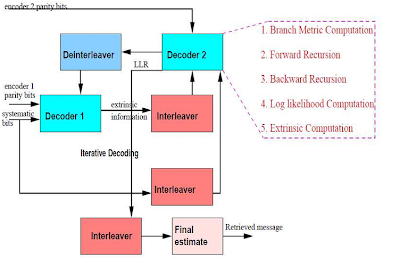
      The turbo code decoder is an iterative Maximum A posteriori (MAP) algorithm. MAP algorithms use a Bayesian analysis of the channel transition probabilities and the state diagram of the encoder to estimate the most likely transmitted sequence of data bits based on the received sequence of data and code bits. The decoder sequentially decodes the results from each constituent encoder. 

      The results of each of these steps are fed to the next step as a-priori information called extrinsic data. After processing the results of all constituent codes, the algorithm goes back to the first constituent code and repeats the process see Figure below.

Turbo-Encoder

1/09/2011 12:16:00 PM 0
Turbo-Encoder

     Turbo code encoders are a concatenation of systematic encoders referred to as constituent codes. (Systematic encoders pass both uncoded data and code bits.) The data is grouped into blocks before coding. Many variations of concatenation have been used: e.g., parallel, serial, and product codes.The figure is an example of a two-constituent code, parallel concatenated turbo encoder.


What's the Turbo-code ?

1/09/2011 12:10:00 PM 0
What's the Turbo-code ?

       Turbo coding is a forward error correction (FEC) scheme. Iterative decoding is the key feature of turbo codes. Turbo codes consist of concatenation of two convolution codes. Turbo codes give better performance at low signal to noise ratio (SNR). 

       Interestingly, the name Turbo was given to this codes because of the cyclic feedback mechanism (as in Turbo machines) to the decoders in an iterative manner.The turbo encoder transmits the encoded bits which form inputs to the turbo decoder. The turbo decoder decodes the information iteratively. Turbo codes can be concatenated in series, parallel or in a hybrid manner. Concatenated codes can be classified as parallel concatenated convolutional codes (PCCC) or serial concatenated convolutional codes (SCCC). 

       In PCCC two encoders operate on the same information bits. In SCCC, one encoder encodes the output of another encoder. The hybrid concatenation scheme consists of the combination of both parallel and serial concatenated convolutional codes. The turbo decoder has two decoders that perform iterative decoding. 

we will speak about Encoder next post then Decoder

Friday, December 31, 2010

Hello everybody

12/31/2010 02:32:00 PM 2
Hello everybody
Hello ,
My name is mahmoud . A communications engineer .I'd like to share all things that i know with you .This blog will discuss all things about Communications engineering and Communications networks as cellular ( GSM , UMTS and LTE ) and networks ( WiFi - WiMAX ).
I wish that i can help each one who needing help or searching for any information .
Thanks ,
Mahmoud