Telecommunications Blog: LTE

A blog for mobile communications systems GSM , UMTS and LTE

Recomended

Showing posts with label LTE. Show all posts

Tuesday, March 27, 2012

what's 4G LTE-Advanced ?

3/27/2012 12:46:00 PM 0
what's 4G LTE-Advanced ?
The following essential landmark may be the standardization associated with LTE-Advanced (LTE Rel. 10 and beyond). To ensure that the actual mobile telecoms technologies will be able to come up with technology that could contend, you ought to make sure that brand new mobile technology are now being developed as well as created. This is actually the thinking at the rear of beginning the introduction of the brand new LTE-Advanced techniques, showing the actual technologies as well as building the actual LTE-Advanced requirements.


 While LTE's peak downlink speed is theoretically 300 Mbps, LTE-Advanced can ostensibly reach 1 Gbps but realistically would get only 100 Mbps in everyday use. LTE's uplink peak rates of 75 Mbps pale in comparison to LTE Advanced's 500 Mbps.

 Along with function beginning upon LTE-Advanced, numerous crucial specifications as well as crucial functions tend to be visiting lighting. While not set however within the specs, there are lots of higher level is designed for your brand new LTE-Advanced standards. These types of will have to become confirmed and far function continues to be carried out within the specs prior to they are almost all set. 

Presently a few of the primary heading is designed with regard to LTE-Advanced is visible beneath :-
  1. Peak data rates : downlink - 1 Gbps; uplink - 500 Mbps.
  2. Spectrum efficiency : 3 times greater than LTE.
  3. Peak spectrum efficiency : downlink - 30 bps/Hz; uplink - 15 bps/Hz.
  4. Spectrum use: the ability to support scalable bandwidth use and spectrum aggregation where non-contiguous spectrum needs to be used.
  5. Latency : from Idle to Connected in less than 50 ms and then shorter than 5 ms one way for individual packet transmission.
  6. Cell edge user throughput to be twice that of LTE.
  7. Average user throughput to be 3 times that of LTE.
  8. Mobility : Same as that in LTE
  9. Compatibility : LTE-Advanced shall be capable of interworking with LTE and 3GPP legacy systems. 
LTE-Advanced would to be moving in numerous areas within 2013, along with suitable devices as well as gadgets growing together with this particular release.

    Thursday, March 22, 2012

    lte service providers

    3/22/2012 12:39:00 PM 0
    lte service providers
    This is a listing of businesses that are offering LTE technologies associated parts.


    4M Wireless designs and develops leading edge products to enable fourth generation mobile wireless based on the latest 3GPP Long Term Evolution (LTE) standards.


    1st to deliver 3GPP LTE design and style automation, sign generation and also sign analysis equipment, Agilent has recently included protocol test and network signaling analysis remedies.


    You can transform to an all IP LTE network to reduce your cost per megabit, increase capacity, and build a service-aware infrastructure for mobile broadband services.


    Altair Semiconductor is a leading developer of ultra-low power, small footprint and high performance 4G chips for LTE.


    Anritsu continues to be taking part positively within the 3GPP standardization of those brand new technology simultaneously because operating carefully using the main infra-structure, chip-set as well as fatal programmers.


    The Aricent Group is a global innovation and technology services company that helps clients imagine, commercialize, and evolve products and services for the connected world.
    As a member of the 3GPP, Aricent is committed to investing in developing and supporting solutions for Long Term Evolution (LTE).


    It provides a complete portfolio of software solutions for air interface monitoring, benchmarking, Mobile Applications, and analysis.


    Founded in 1986 in Berlin, AVM is one of the top two manufacturers of broadband devices in Europe.


    Bridgewater Systems, the global leader in intelligent broadband controls, provides pre-integrated solutions for mobile and converged operators to Transform their networks to 4G: WiMAX, LTE, and WiMAX to LTE.

    Wednesday, March 14, 2012

    what is 4G LTE cellular technology ?

    3/14/2012 02:20:00 PM 0
    what is 4G LTE cellular  technology ?
    Its full name is 3GPP Long Term Evolution for the Universal Mobile Telecommunications System, or 3GPP UMTS LTE for short. LTE (Long Term Evolution) is a wireless broadband technology designed to support roaming Internet access via cell phones and handheld devices.


    Where the current generation of mobile telecommunication networks are collectively known as 3G, LTE is marketed as 4G.


    Requirements :

    • Reduced cost per bit
    • Increased service provisioning – more services at lower cost with better user experience
    • Flexibility of use of existing and new frequency bands
    • Simplified architecture, Open interfaces
    • Allow for reasonable terminal power consumption

    LTE Specifications :


     LTE uses two different types of air interfaces (radio links), one for downlink (from tower to device), and one for uplink (from device to tower).For the downlink, LTE uses an OFDMA (orthogonal frequency division multiple access) air interface For the uplink (from device to tower), LTE uses the DFTS-OFDMA (discrete Fourier transform spread orthogonal frequency division multiple access) scheme of generating a SC-FDMA (single carrier frequency division multiple access) signal. 

    The major difference between the OFDMA signal for downlink and the SC-FDMA signal for uplink is that it uses a discrete Fourier transform function on the data to convert it into a form that can be used to transmit.

    Monday, February 27, 2012

    4G LTE air interface - Radio Frequency Aspects

    2/27/2012 08:50:00 AM 0
    4G LTE air interface - Radio Frequency Aspects
    LTE air interface adopts OFDMA (orthogonal frequency division multiple access) for the downlink and SC-FDMA (single-carrier frequency domain multiple access) for the uplink. It employs AMC (adaptive modulation and coding) as well as a number of optional MIMO (multiple-input multiple-output) antenna techniques and interference management methods for potential performance enhancements.

    Telecommunications Blog

    One of the first things to note about LTE is the integration between the Frequency Division Duplex (FDD) and Time Division Duplex (TDD) radio access modes. In the previous Universal Mobile Telephone System (UMTS) specifications, which also supported FDD and TDD, the RF specifications for the UE FDD, UE TDD, base station FDD and base station TDD modes were covered in separate documents.

    However, the early decision by 3GPP to fully integrate FDD and TDD modes for LTE has resulted in only one RF specification document each for the UE and the eNB. With the higher level of integration between the two modes, the effort required to support them should be less than it was in the past.

    Channel Bandwidths:

    LTE was designed from the start to support six different channel bandwidths. These are 1.4 MHz, 3 MHz, 5 MHz, 10 MHz, 15 MHz and 20 MHz. In addition to this the subcarriers are spaced 15 kHz apart from each other. To maintain orthogonality, this gives a symbol rate of 1 / 15 kHz = of 66.7 µs.

    Earlier versions of the specifications also supported 1.6 MHz and 3.2 MHz for interworking with LCR TDD, but these were removed when the LTE TDD frame structure was aligned with the FDD frame structure rather than the TD-SCDMA frame structure from UMTS.

    Monday, April 25, 2011

    LTE vs WiMAX : 4G Comparison

    4/25/2011 03:54:00 AM 0
    LTE vs WiMAX : 4G Comparison
      Both are 4G technologies designed to move data rather than voice. Both are IP networks based on OFDM (Orthogonal Frequency Division Multiplexing) technology.

       WiMax is based on a IEEE standard (802.16),Depending on the spectrum alloted for WiMax deployments and how the network is configured, this can mean a WiMax network is cheaper to build.

         WiMAX offers peak wireless data speeds of up to 60 Mbps on the downstream and 25 Mbps for sending data upstream.

        Long Term Evolution (LTE), can ferry data to you at download speeds of 100 Mbps and support upload speeds of 50 Mbps.

        That means you can download about two 5-minute MP3 files every second. Think about that. Sure, it would only take WiMAX about seven minutes to download a single 5-minute MP3 file, which is still fast, but it’s nowhere near the theoretical scale of LTE.


    LTE World summit 2011, 17-18 May 2011 at Amsterdam RAI

    4/25/2011 01:11:00 AM 0
    LTE World summit 2011, 17-18 May 2011 at Amsterdam RAI
    7th LTE World summit is schedule on 17-18 May 2011 at Amsterdam RAI.


    Features of this event will be :

    Now in its 7th Year! This is THE LTE event of the year!
    • 2500+ Attendees from 100+ countries
    • 150+ High-level speakers
    • 120+ Exhibitors, meeting rooms & hospitality suites
    • 100+ Operator Case Studies
    • 50%+ Director-level and above attendance - meet the decision makers here!

    Thursday, April 21, 2011

    4G LTE: MIMO and MRC

    4/21/2011 04:44:00 AM 0
    4G LTE: MIMO and MRC
    MIMO and MRC:-

        o LTE system uses MIMO (multiple input multiple output) as advanced multiple antenna technique in order to achieve the ambitious requirements for throughput and spectral efficiency.
        o maximal ratio combining (MRC) : is used to enhance link reliability in challenging propagating conditions when signal strength is  low and multipath conditions are challenging. 
     

     Downlink MIMO:-

        o a 2x2 configuration for MIMO i.e. 2 transmit antennas at the base station and 2 receive antennas at the terminal side. 

    Saturday, April 16, 2011

    SC-FDMA (Single Carrier Freq Domain Multiple Access)

    4/16/2011 04:47:00 AM 2
    SC-FDMA (Single Carrier Freq Domain Multiple Access)
    SC-FDMA (Single Carrier Freq Domain Multiple Access) used in Up-Link in LTE.

        o The system uses SC-FDMA as uplink multiple access method instead OFDMA to decrease the PAPR and power requirements.

        o It offers the same degree of multipath mitigation but because the transmission is
    on single carrier PAPR is lower.


         o The basic idea is to add cyclic prefix to the mapped symbols and in the receiver
    multipath distortion can be handled by the same method as OFDM (carrier based equalization).

    Thursday, April 14, 2011

    TELUS to launch 4G LTE in Canada in 1st H 2012

    4/14/2011 06:58:00 PM 1
    TELUS to launch 4G LTE in Canada in 1st H 2012
       LTE technology supports manufacturer’s rated peak download speeds of up to 150 megabits per second (Mbps) and upload speeds of up to 70 Mbps.

       Canadian operator TELUS has announced the plan to launch of LTE network 1st H 2012. Following field testing in 2011 and the completion of an RFP process currently underway, construction on TELUS' LTE network will begin in the latter half of 2011 in major urban markets across Canada. 

       Telus – the country’s third-largest operator – said that construction of the new network will begin in the latter half of 2011 in “major urban markets” across Canada. It will initially operate on

    Wednesday, April 13, 2011

    Alcatel-Lucent and nTelos Wireless complete LTE field trial

    4/13/2011 03:52:00 PM 0
    Alcatel-Lucent and nTelos Wireless complete LTE field trial
       Virginia-based nTelos Wireless and Alcatel-Lucent have accomplished an end-to-end Long Term Evolution (LTE) field trial in Waynesboro, Va.

       “This trial enables us to make informed decisions on how to smoothly evolve our network and incorporate 4G LTE into the existing infrastructure, particularly in terms of end-user performance, throughput, latency and Quality of Experience,” said Bobby McAvoy, Senior Vice President, Wireless Engineering & Operations for nTelos Wireless.

       For this trial, Alcatel-Lucent provided an end-to-end integrated solution including 4G LTE base

    Infrax Systems (IFXY) Announces the Availability of New 1.4-1.6 GHz Upgradeable WiMAX / LTE Base Station for Rural Broadband Networks

    4/13/2011 03:37:00 PM 0
    Infrax Systems (IFXY) Announces the Availability of New 1.4-1.6 GHz Upgradeable WiMAX / LTE Base Station for Rural Broadband Networks
        Infrax Systems, Inc. (OTCBB: IFXY), a global provider of unified Smart Grid-related products and services for the Energy and Utility industries, today announced the availability of a new upgradeable WiMAX/LTE base station. This new base station option allows network operators and service providers to utilize the desirable 1.4-1.6 GHz frequencies. The addition of these new base stations will provide operators of rural broadband networks better range than the typical 2.5 or 3.5 GHz WiMAX. These new base stations also have the capability of being upgraded from WiMAX (802.16e) to Long Term Evolution (LTE) via firmware. These modular 4G base stations can even provide the ability to change to a different frequency by changing radio modules to provide more longevity of the platform and protect network operator's investments.

       The American Reinvestment and Recovery Act appropriated $7.2 billion for the Department of Agriculture’s Rural Utilities Service (RUS) and the Department of Commerce’s National

    Ericsson to support China Mobile's TD-LTE Trial Network in the City of Shenzhen

    4/13/2011 03:23:00 PM 0
    Ericsson to support China Mobile's TD-LTE Trial Network in the City of Shenzhen
       China Mobile has selected Ericsson to participate in the world’s largest TD-LTE trial network deployment to date. With the approval of the Chinese Ministry of Industry and Information Technology (MIIT), Ericsson will build trial network in the city of Shenzhen.

       The approval by MIIT follows the successful completion of interoperability tests of Ericsson's TD-LTE network equipment with multiple chipset manufacturers. As part of its efforts to further develop the global ecosystem, Ericsson is proactively conducting interoperability tests with leading international players such as ST-Ericsson and Qualcomm.

      "China Mobile has always been a formidable force in driving the evolution of telecommunications technologies. As a longtime strategic partner to China Mobile, Ericsson will fully support our customer in its tremendous endeavor to make TD-LTE a reality in the

    Epitiro tests TeliaSonera's LTE network performance

    4/13/2011 03:07:00 PM 0
    Epitiro tests TeliaSonera's LTE network performance
       Epitiro has completed the independent speed, latency and voice quality-of-experience analysis on a commercially available LTE network. Tests recorded peak broadband download speeds of 48Mbps (36.1Mbps mean) where as Mean latency was just 23ms.

      Epitiro, at the same time, tested TeliaSonera's legacy 3G network; LTE delivered mean download speeds nine times faster, and its latency was five times faster. Analysis of IP calls to the UK, made using voice over LTE (VoLTE), found the quality to be ‘excellent’ on average with only 1 call in 298 being of inferior quality.

      “Based on our observations, this LTE rollout is directly comparable to high-speed fixed

    Monday, April 11, 2011

    4G LTE structure

    4/11/2011 03:18:00 PM 0
    4G LTE structure
    LTE PHY layer block diagram:-

    We can implement LTE Physical layer Block diagram in Matlab .


    Frame structure: it is FDD frame which is 10ms divided into 10 subframes each
    of 1ms & each subframe is divided into 2 slots of 0.5 ms which carry 6 or 7 OFDM
    symbol.

    Sunday, April 10, 2011

    4G LTE Key Features ( EPS to EPC)

    4/10/2011 03:09:00 PM 0
    4G LTE Key Features ( EPS to EPC)
    EPS to EPC

       A key feature of the EPS is the separation of the network entity that performs control-plane functionality (MME) from the network entity that performs bearer-plane functionality (SGW) with a well defined open interface between them (S11).


    LTE S11: -

        An IP interface between MME and SGW! GTPv2 is the protocols used at the application

    4G LTE Physical layer overview

    4/10/2011 02:22:00 PM 0
    4G LTE Physical layer overview
    What is LTE?

        3GPP LTE (Long Term Evolution) is the name given to a project that aims to improve the
    UMTS mobile phone and it is not a standard but it will result in the release 8 of UMTS
    and it can be considered the real 3.9G & invited to join the 4G family.

    Technical specifications:-


    LTE PHY layer block diagram:-

    Wednesday, January 12, 2011

    Using SC-FDMA in LTE

    1/12/2011 02:51:00 AM 0
    Using SC-FDMA in  LTE

         Single carrier frequency division multiple access (SC-FDMA) has been adopted by the third generation partnership project (3GPP) for uplink transmission in technology standardized for long term evolution (LTE) of cellular systems.SC-FDMA was chosen because it combines the low PAPR techniques of single-carrier transmission systems, such as GSM and CDMA, with the multi-path resistance and flexible frequency allocation of OFDMA. 
     
         Data symbols in the time domain are converted to the frequency domain using a discrete Fourier transform (DFT).Then in the frequency domain they are mapped to the desired location in the overall channel bandwidth before being converted back to the time domain using an inverse FFT (IFFT).


    Sunday, January 9, 2011

    Turbo-Decoder

    1/09/2011 12:22:00 PM 0
    Turbo-Decoder

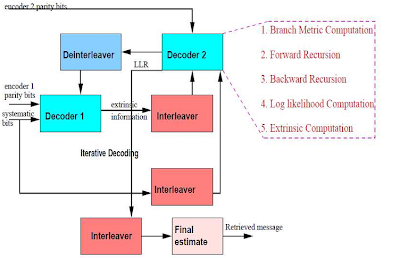
          The turbo code decoder is an iterative Maximum A posteriori (MAP) algorithm. MAP algorithms use a Bayesian analysis of the channel transition probabilities and the state diagram of the encoder to estimate the most likely transmitted sequence of data bits based on the received sequence of data and code bits. The decoder sequentially decodes the results from each constituent encoder. 

          The results of each of these steps are fed to the next step as a-priori information called extrinsic data. After processing the results of all constituent codes, the algorithm goes back to the first constituent code and repeats the process see Figure below.

    Turbo-Encoder

    1/09/2011 12:16:00 PM 0
    Turbo-Encoder

         Turbo code encoders are a concatenation of systematic encoders referred to as constituent codes. (Systematic encoders pass both uncoded data and code bits.) The data is grouped into blocks before coding. Many variations of concatenation have been used: e.g., parallel, serial, and product codes.The figure is an example of a two-constituent code, parallel concatenated turbo encoder.


    What's the Turbo-code ?

    1/09/2011 12:10:00 PM 0
    What's the Turbo-code ?

           Turbo coding is a forward error correction (FEC) scheme. Iterative decoding is the key feature of turbo codes. Turbo codes consist of concatenation of two convolution codes. Turbo codes give better performance at low signal to noise ratio (SNR). 

           Interestingly, the name Turbo was given to this codes because of the cyclic feedback mechanism (as in Turbo machines) to the decoders in an iterative manner.The turbo encoder transmits the encoded bits which form inputs to the turbo decoder. The turbo decoder decodes the information iteratively. Turbo codes can be concatenated in series, parallel or in a hybrid manner. Concatenated codes can be classified as parallel concatenated convolutional codes (PCCC) or serial concatenated convolutional codes (SCCC). 

           In PCCC two encoders operate on the same information bits. In SCCC, one encoder encodes the output of another encoder. The hybrid concatenation scheme consists of the combination of both parallel and serial concatenated convolutional codes. The turbo decoder has two decoders that perform iterative decoding. 

    we will speak about Encoder next post then Decoder