Telecommunications Blog: OFDM

A blog for mobile communications systems GSM , UMTS and LTE

Recomended

Showing posts with label OFDM. Show all posts

Wednesday, January 12, 2011

What's OFDM-MIMO ?

1/12/2011 11:11:00 AM 1
What's OFDM-MIMO ?
 Multiple Input Multiple Output (MIMO)

     One building block for next-generation wireless access, MIMO (multiple-input, multiple-output), is an advanced antenna technology that can carry 4 to 5 times more data traffic than today’s most advanced UMTS-HSDPA-ready (3G) networks. A network design incorporating MIMO technology provides the scalability needed to quickly deliver multimedia content to the mass market. With MIMO, for example, a ½ megabit picture can be downloaded in a half second or a 30-megabit video in half a minute. 

We know that there are 4 types : SISo , SIMO , MISO and MIMO  


SISo : Single i/p , Single O/p
SIMO : Single i/p , Multi o/p
MISO : Multi i/p , Single o/p


OFDM Advantages and Disadvantages

1/12/2011 11:01:00 AM 1
OFDM Advantages and Disadvantages
    The major advantage of OFDM is its robustness against multi path propagation. Thus, it is suitable to be implemented in wireless environments. The introduction of cyclic prefix made OFDM system resistance to time dispersion. OFDM symbol rate is low since a data stream is divided into several parallel streams before transmission. This make the fading is slow enough for the channel to be considered as constant during one OFDM symbol interval.


Orthogonal Frequency Division Multiplexing (OFDM)

1/12/2011 10:46:00 AM 1
Orthogonal Frequency Division Multiplexing (OFDM)
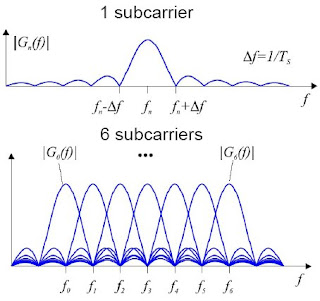
      Orthogonal Frequency Division Multiplexing (OFDM) is a multicarrier modulation technique. OFDM provides high bandwidth efficiency because the carriers are orthogonal to each other and multiple carriers share the data among themselves. The main advantage of this transmission technique is their robustness to channel fading in wireless communication environment.

     OFDM is an attractive modulation scheme used in broadband wireless systems that encounter large delay spreads. OFDM avoids temporal equalization altogether, using a cyclic prefix technique with a small penalty in channel capacity.