Telecommunications Blog: WIMAX

A blog for mobile communications systems GSM , UMTS and LTE

Recomended

Showing posts with label WIMAX. Show all posts

Wednesday, April 4, 2012

wimax network planning part 1

4/04/2012 01:00:00 PM 0
wimax network planning part 1
WiMAX (Worldwide Interoperability for Microwave Access) ( 802.16 - 802.16e ).WIMAX was developed to promote conformance and interoperability of the IEEE 802.16 standard (Wireless MAN).


we will learn how we can planning a wimax network but first we should know some important things .

 
Frequency Planning :

         • The frequency re-use is extremely important in reducing the interference and therefore increasing the capacity
         • Off-the-shelf frequency assignment do not minimize the deployment cost for your system.
         • An optimum frequency assignments can be applied by considering
         • Site locations
         • Power levels
         • User distribution
         • Spectrum availability
         • Geography and building characteristics.


Site Features Optimization

         • Number of antennas
         • Antenna directions
         • Antenna heights
         • Antenna powers
         • Antenna tilts
         • Number of channels
         • Frequency of channels
         • OFDM Parameters
         • Cyclic prefix
         • Number of subchannels
         • Subchannelization rates
         • Available modulations
         • Handover parameters
         • MIMO settings
         • Uplink / Downlink traffic ratios
         • Voice over IP related issues
         • Backhaul planning: fiber, minilink, HDSL…. capacity issues

Thursday, May 5, 2011

MAC Layer in WiMAX IEEE 802.16

5/05/2011 04:11:00 PM 0
MAC Layer in WiMAX IEEE 802.16
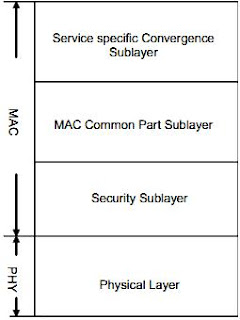
  The MAC layer of IEEE 802.16 is designed to serve sparsely distributed stations with high data rates, where the SSs are not required to listen to the other stations like the MAC in IEEE 802.11. 

  The BS schedules the transmissions of the corresponding SSs in advance. The MAC of WiMAX is reservation-based and contention-free. The SSs need to contend only when they access the channel for the first time at the connection admission control stage. 

  The reservation-based resource allocation allows the WiMAX BS to serve a large number of SSs as well as the guarantee of QoS in the connection level for both uplink and downlink traffic. 

  Compared with 802.16, Wireless Local Area Networks (WLAN) based on IEEE 802.11 terminals usually have intermittent  traffic that contends every time before transmitting, where the efficiency is significantly impaired when more stations enter the network.


  The main purpose of the MAC protocol is the sharing of radio channel resources among
multiple accesses of different users. The MAC also contains a separate security sublayer handling authentication, secure key exchange, and encryption.

Tuesday, May 3, 2011

WiMAX IEEE 802.16 family

5/03/2011 08:08:00 PM 0
WiMAX IEEE 802.16 family
WiMAX IEEE 802.16 family :.
  •  IEEE 802.16a: The standard specifies the operation from 2GHz to 11GHz, both licensed and license exempts. Because the signals at lower frequency can penetrate barriers and thus a line-of-sight connection between the transceiver and receiver is not required, most commercial interests have focused mainly on the lower frequency ranges. Under this premise, IEEE 802.16a standard was thus completed in January 2001. It enables the WiMAX implementations with better flexibility while maintaining the data rate and transmission range. IEEE 802.16a also supports mesh deployment, which can extend the network coverage and increase the overall throughput.

  •  IEEE 802.16b:  This extension increases the spectrum to the 5 and  6 GHz frequency bands, which provides QoS guarantee to ensure priority transmission for real-time applications and to differentiate service classes for different traffic types.

  •  IEEE 802.16c: As the Work Group’s initial interest, IEEE 802.16c defines a 10 to 66 GHz system profile that standardizes more details of the technology. These high frequency bands have more available bandwidth, but the signals cannot diffract the obstacles and require line of sight deployment. 

  •  IEEE 802.16d:  Approved in June 2004, IEEE 802.16d upgrades the 802.16a
standard. This extension aims to improve performance for 802.16 especially in the
uplink traffic.

  •  IEEE 802.16e:  This technology standardizes networking between fixed base stations (BSs) and mobile base stations (MSs), rather than just between base stations and fixed recipients. IEEE 802.16e enables the high-speed signal handoffs necessary for communications with users moving in vehicles. It promises to support mobility up to speeds of 70-80mi/h. The subscriber stations (SSs) could be personal communication devices such  as mobile phones and laptops.

We will continue the family next posts .

Monday, April 25, 2011

LTE vs WiMAX : 4G Comparison

4/25/2011 03:54:00 AM 0
LTE vs WiMAX : 4G Comparison
  Both are 4G technologies designed to move data rather than voice. Both are IP networks based on OFDM (Orthogonal Frequency Division Multiplexing) technology.

   WiMax is based on a IEEE standard (802.16),Depending on the spectrum alloted for WiMax deployments and how the network is configured, this can mean a WiMax network is cheaper to build.

     WiMAX offers peak wireless data speeds of up to 60 Mbps on the downstream and 25 Mbps for sending data upstream.

    Long Term Evolution (LTE), can ferry data to you at download speeds of 100 Mbps and support upload speeds of 50 Mbps.

    That means you can download about two 5-minute MP3 files every second. Think about that. Sure, it would only take WiMAX about seven minutes to download a single 5-minute MP3 file, which is still fast, but it’s nowhere near the theoretical scale of LTE.


Sunday, April 3, 2011

IEEE approve next generation 802.16m WiMAX standard

4/03/2011 12:46:00 PM 0
IEEE approve next generation 802.16m WiMAX standard
    The IEEE Standards Association has given its seal of approval to the next generation WiMAX standard, dubbed 802.16m. The new standard supports a “wide range of data rates in multiple user environments” and has a theoretical maximum throughput of around 300Mbps.


     ” The standards group notes that 802.16m will provide the speed and performance necessary to support future advanced services and applications for next generation broadband mobile communications.”  said Dr. Roger Marks, Chairman of the 802.16 Working Group.

Saturday, January 22, 2011

Fundamental WiMAX Concepts

1/22/2011 02:16:00 AM 1
Fundamental WiMAX Concepts
  WiMAX has four fundamental architectural components:


Base Station (BS) : 

      The BS is the node that logically connects wireless subscriber devices to operator networks. The BS maintains communications with subscriber devices and governs access to the operator networks. A BS consists of the infrastructure elements necessary to enable wireless communications, i.e., antennas, transceivers, and other electromagnetic wave transmitting equipment.

      BSs are typically fixed nodes, but they may also be used as part of mobile solutions , for example, a BS may be affixed to a vehicle to provide communications for nearby WiMAX devices. A BS also serves as a Master Relay-Base Station in the multi-hop relay topology .


Sunday, January 2, 2011

An intro to WiMAX

1/02/2011 12:36:00 AM 0
An intro to WiMAX
WiMAX (Worldwide Interoperability for Microwave Access) ( 802.16 - 802.16e )


     It was defined by the WiMAX Forum is a telecommunication protocol that provided fixed and fully mobile broadband access (IEEE 802.16e ). WIMAX was developed to promote conformance and interoperability of the IEEE 802.16 standard (Wireless MAN). Meanwhile WIMAX Forum is the organization which dedicated to certifying the interoperability of broadband wireless access (BWA). WIMAX Forum will conduct the testing to ensure that different mobile broadband system from many manufactures work properly.