Telecommunications Blog: 5G

A blog for mobile communications systems GSM , UMTS and LTE

Recomended

Showing posts with label 5G. Show all posts

Tuesday, May 26, 2020

5G technology Advantages & Disadvantages as a technical

5/26/2020 05:47:00 PM 0
5G technology Advantages & Disadvantages as a technical


So what is 5G?

In a nutshell, 5G or 5th generation mobile networks or wireless systems, is the next phase in mobile technology. It promises to improve coverage, battery consumption, and connection speeds, as well as support for other wireless products apart from phones and tablets.

5G needs more investment in infrastructure as it has higher frequency than 4G so the coverage will decrease significantly hence more no of towers required which will make it unfeasible as 4G Macro cells gives coverage of 2 kms and 5G coverage is just 500 to 800 metres.
5G has speed in terms of 5–10Gbps which will easily fill the memory space of smartphones in few seconds and huge size of battery(10000 mAh) is required and heat dissipation will also increase significantly mmWave version of 5G needs Small cells as line of sight between tower and cell phone is required which will be burden to Telecos and Consumers 5G is practically unfeasible for now and it’s not an innovation but an incremental improvement over 4G by increasing frequency.
Wi-Fi is already present as a better Alternative to 5G which is way cheaper and best for Home broadband ,reliable and high speed. Coverage & Speed of both are same.
Secondly VoLTE technology is used for Voice Calls or 2G,3G is used for voice calls there is no such standard for 5G for voice calls till now, there are also limited VoLTE phones in world.

Important Advantages

There are several advantages of 5G technology, some of the advantages have been shown in the above Ericsson image, and many others are described below −
  • High resolution and bi-directional large bandwidth shaping.
  • Technology to gather all networks on one platform.
  • More effective and efficient.
  • Technology to facilitate subscriber supervision tools for the quick action.
  • Most likely, will provide a huge broadcasting data (in Gigabit), which will support more than 60,000 connections.
  • Easily manageable with the previous generations.
  • Technological sound to support heterogeneous services (including private network).
  • Possible to provide uniform, uninterrupted, and consistent connectivity across the world.


Sunday, May 17, 2020

Spectrum for 5G NR above 52.6 GHz

5/17/2020 12:50:00 PM 0
Spectrum for 5G NR above 52.6 GHz
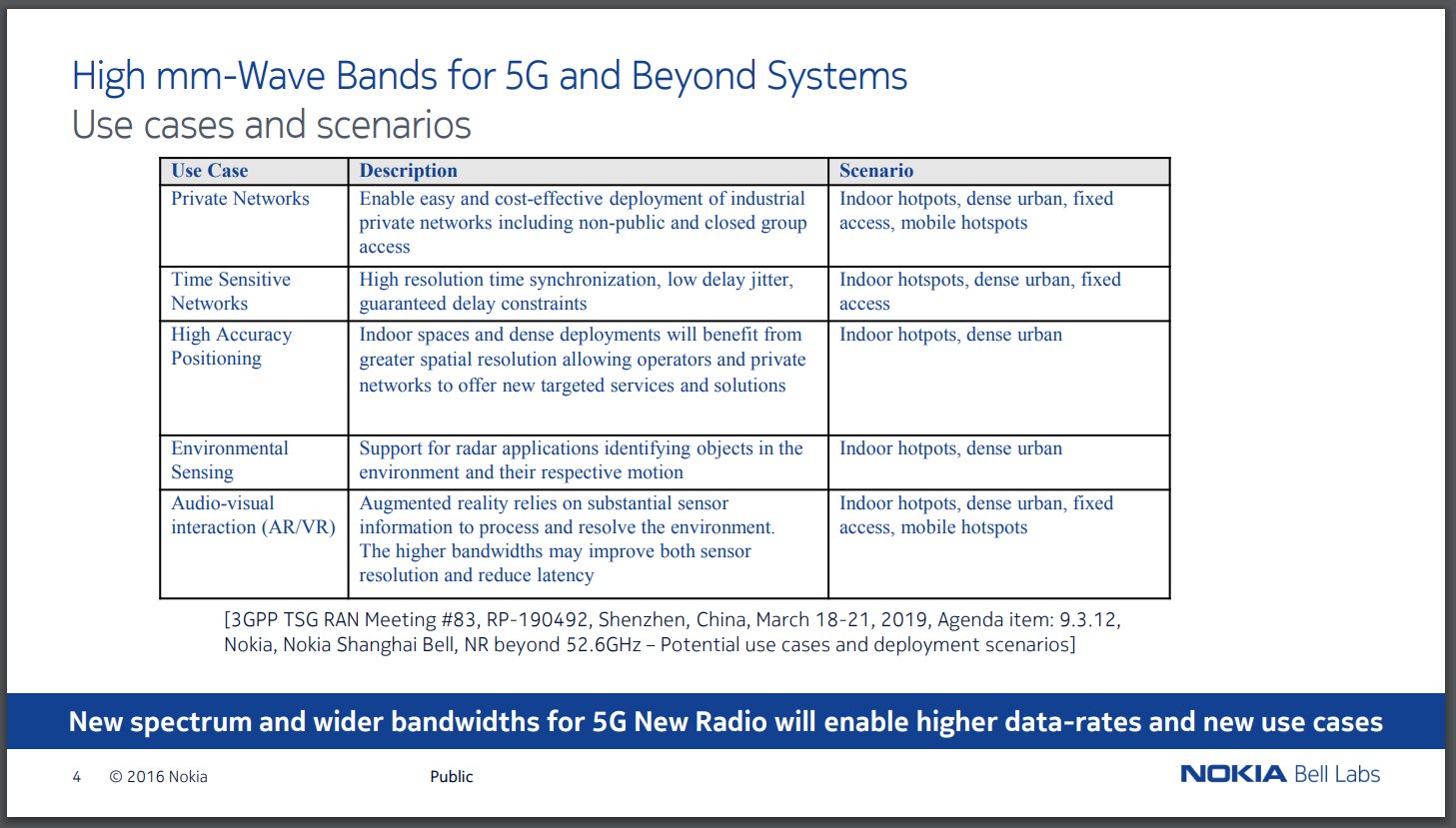
The relatively underutilized millimeter-wave (mmWave) spectrum offers excellent opportunities to provide high speed data rate, low latency, and high capacity due to the enormous amount of available contiguous bandwidth. However, operation on bands in frequencies above 52.6GHz will be limited by the performance of devices, for example, poor power amplifier (PA) efficiency and larger phase noise impairment, the increased front-end insertion loss together with the low noise amplifier (LNA) and analog-to-digital converter (ADC) noise. In addition, bands in frequencies above 52.6GHz have high propagation and penetration losses challenge. Even so, various use cases are envisioned for NR operating in frequencies between 52.6GHz and 114.25GHz. Some of the use cases are illustrated in Figure 5.1-1 and following section provide detailed description of the uses cases. It should be noted that there is not a 1-to-1 mapping of use cases and wireless interfaces, e.g. Uu, slidelink, etc. Various wireless interfaces could be applicable to various uses cases described.


  • High data rate eMBB
  • Mobile data offloading
  • Short-range high-data rate D2D communications
  • Vertical industry factory application
  • Broadband distribution network
  • Integrated access backhaul (IAB)
  • Factory automation/Industrial IoT (IIoT)
  • Augmented reality/virtual reality headsets and other high-end wearables
  • Intelligent Transport Systems (ITS) and V2X
  • Data Center Inter-rack Connectivity
  • Smart grid automation
  • Radar/Positioning
  • Private Networks
  • Critical medical communication


Within the range 52.6 to 116 GHz, the frequency bands 66-76 GHz (including 66-71 and 71-76 GHz) and 81-86 GHz are being studied under WRC-19 Agenda Item 1.13 for potential IMT identification. Results of sharing and compatibility studies, potential technical and regulatory conditions are included in Draft CPM Report, and the final decisions are to be made in WRC-19 with respect to IMT identification or no IMT identification, along with the corresponding technical and regulatory conditions.

For 66-71 GHz, Studies were carried out for the ISS, MSS (Earth-to-space) indicating that sharing is feasible, with a need for separation distance in the order of few kilometers for the case of MSS (space-to-Earth). The need for studies addressing interference from IMT towards RNS is still under debate. Thus, final conclusions in the regulatory and technical conditions for this band cannot be drawn.

For 71-76 GHz, studies were carried out for the FS, RLS and FSS (space-to-Earth) indicating that sharing with FS and FSS is feasible. However, additional limits of the IMT BS and UE unwanted emissions is needed to protect RLS in the adjacent frequency band 76-81 GHz.

For 81-86 GHz, studies were carried out for the FS, FSS (Earth-to-space), RAS (in band and adjacent band), EESS (passive) and RLS. Studies are not needed for the SRS (passive), as this service is dealing with sensors around other planets and no interference issue is expected. Studies were also not carried out for the MSS. The results of those studies indicate that sharing with FS, FSS and RAS (in band and adjacent band) is feasible. Notice that additional limits of the IMT BS and UE unwanted emissions would be needed to ensure protection of EESS (passive) in the adjacent frequency band 76-81 GHz and RLS in the adjacent frequency band 86-82 GHz.


RRC Message in 5G Stand-alone

5/17/2020 12:45:00 PM 0
RRC Message in 5G Stand-alone
Radio access technology the 3GPP 38.331 Rel. 15 protocol is suitable as well. Hence, some parameters mentioned in the standard paper will never be seen in EN-DC. A perfect example is S-NSSAI (Single Network Slice Selection Assistance Information), because network slicing requires the connection with a 5G core network as a prerequisite.