Telecommunications Blog: Turbo code

A blog for mobile communications systems GSM , UMTS and LTE

Recomended

Showing posts with label Turbo code. Show all posts

Wednesday, January 19, 2011

Turbo Code Applications 2

1/19/2011 01:16:00 PM 0
Turbo Code Applications 2
Terrestrial telephony: 
 
    Turbo codes are suited for down-to-earth applications such as terrestrial telephony. Satellite technology provides global coverage and service. UMTS is being standardized to ensure an efficient and effective interaction between satellite and terrestrial networks. 

    An important third generation cellular standard is cdma2000, which is standardized by the third generation partnership project (3GPP). As in UMTS (Universal Mobile Telephone Service), cdma2000 systems use turbo codes for forward error correction (FEC). While the turbo codes used by these two systems are very similar, the differences lie in the interleaving algorithm, the range of allowable input size and the rate of constituent RSC encoders. 

Turbo Code Applications 1

1/19/2011 01:14:00 PM 0
Turbo Code Applications 1

Mobile radio: 
 
     Few environments require more immunity to fading than those found in mobile communications. For applications where delay vs performance is crucial, turbo codes Offer a wide trade-off space at decoder complexities equal to or better than conventional concatenated code performance. The major benefit is that such systems can work with smaller constraint-length convolutional encoders. The major drawback is decoder latency. Turbo codes with short delay are being heavily researched. Turbo codes generally outperform convolutional and block codes when interleavers exceed 200 bits in length. 

Digital video: 
 

Sunday, January 9, 2011

Turbo-Decoder

1/09/2011 12:22:00 PM 0
Turbo-Decoder

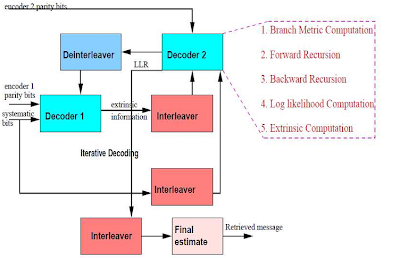
      The turbo code decoder is an iterative Maximum A posteriori (MAP) algorithm. MAP algorithms use a Bayesian analysis of the channel transition probabilities and the state diagram of the encoder to estimate the most likely transmitted sequence of data bits based on the received sequence of data and code bits. The decoder sequentially decodes the results from each constituent encoder. 

      The results of each of these steps are fed to the next step as a-priori information called extrinsic data. After processing the results of all constituent codes, the algorithm goes back to the first constituent code and repeats the process see Figure below.

Turbo-Encoder

1/09/2011 12:16:00 PM 0
Turbo-Encoder

     Turbo code encoders are a concatenation of systematic encoders referred to as constituent codes. (Systematic encoders pass both uncoded data and code bits.) The data is grouped into blocks before coding. Many variations of concatenation have been used: e.g., parallel, serial, and product codes.The figure is an example of a two-constituent code, parallel concatenated turbo encoder.


What's the Turbo-code ?

1/09/2011 12:10:00 PM 0
What's the Turbo-code ?

       Turbo coding is a forward error correction (FEC) scheme. Iterative decoding is the key feature of turbo codes. Turbo codes consist of concatenation of two convolution codes. Turbo codes give better performance at low signal to noise ratio (SNR). 

       Interestingly, the name Turbo was given to this codes because of the cyclic feedback mechanism (as in Turbo machines) to the decoders in an iterative manner.The turbo encoder transmits the encoded bits which form inputs to the turbo decoder. The turbo decoder decodes the information iteratively. Turbo codes can be concatenated in series, parallel or in a hybrid manner. Concatenated codes can be classified as parallel concatenated convolutional codes (PCCC) or serial concatenated convolutional codes (SCCC). 

       In PCCC two encoders operate on the same information bits. In SCCC, one encoder encodes the output of another encoder. The hybrid concatenation scheme consists of the combination of both parallel and serial concatenated convolutional codes. The turbo decoder has two decoders that perform iterative decoding. 

we will speak about Encoder next post then Decoder